
Brain-Based Vision Therapy may help selected squint patients improve eye coordination, binocular vision, focusing, tracking, and depth perception.
If you or your child has a squint eye, also called strabismus, you may already be familiar with treatment options such as glasses, patching, prisms, or surgery. These treatments can be appropriate depending on the type and severity of the squint and the individual’s visual needs.
But there is another important question to consider:
Is the problem only with the position of the eyes, or is there also a problem with how the eyes and brain coordinate vision?
This is where Brain-Based Vision Therapy can become an important part of the conversation for appropriately selected patients.
At Sight First Vision Therapy Clinics, by Dr. Abhinav Maharwal, the assessment goes beyond simply observing where the eye is pointing. It may include evaluating how the eyes move, focus, coordinate with each other, use depth perception, and process visual information.
Based on the results of the evaluation, a personalized Vision Therapy plan might include exercises to improve how both eyes work together, activities to strengthen eye movement control, and other treatments that are suitable for the individual’s needs.
Other advanced treatment options like Red Light Therapy, Low-Level Light or Laser Therapy (LLLT), PEMF, and Syntonics might also be used when suitable.
Squint Is Not Always Just About Where the Eye Is Pointing
When we look at an object, seeing it clearly involves much more than the eyes.
The visual system works through constant communication between the eyes, the nerves that carry visual information, and the brain. Our eyes gather pictures from the world around us, and then our brain takes that information, sorts it out, and puts it together so we can see and knowin what we’re looking at.
If the eyes are not aligned properly, the brain might get different pictures from each eye. In some kids, the brain might block the picture from one eye to avoid confusion or seeing two images at the same time. Over time, this can impact how well someone uses both eyes together and their ability to judge distances.
This is why simply asking, “Can the child see clearly?” may not tell the complete story.
At Sight First Vision Therapy By Dr Ahinav Maharwal, the assessment may therefore consider not only visual acuity and eye alignment, but also the functional relationship between the eyes and brain.
What a Routine Eye Test May Miss
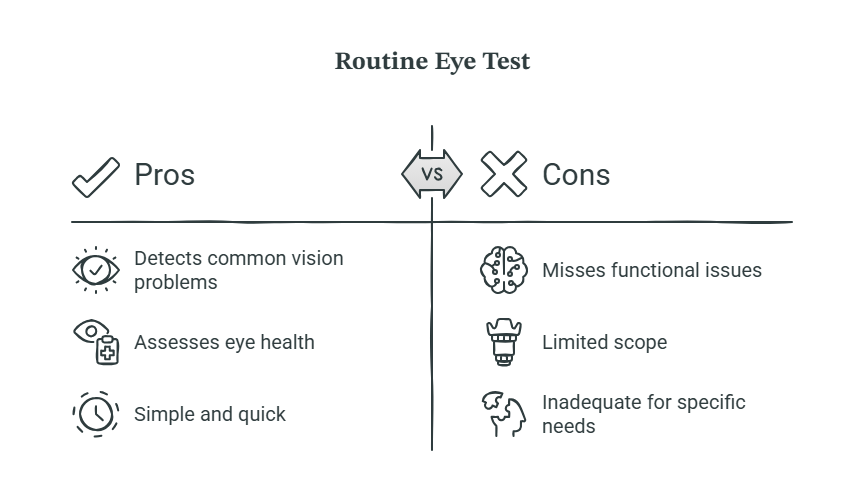
A regular eye checkup helps find problems like blurry vision, crossed eyes, lazy eye, health issues in the eyes, and other related problems. A regular eye checkup isn’t enough on its own; each type of exam is meant for a specific reason.
A standard visual acuity test primarily asks:
“How clearly can you see?”
Functional and binocular vision assessment can explore a broader question:
“How effectively are the two eyes and brain working together?”
A child may therefore have reasonably good visual acuity and still experience difficulties with certain visual skills.
Depending on the child’s needs, functional assessment may consider:
- Fixation – ability to maintain visual attention on a target
- Saccades – controlled eye movements between visual targets
- Pursuits – ability to smoothly follow a moving object
- Eye movement control – accuracy and efficiency of eye movements
- Accommodation – ability to focus at different distances
- Vergence – ability of the eyes to move together appropriately
- Binocular fusion – ability to combine information from both eyes
- Stereopsis – depth perception created through binocular vision
- Suppression – reduced awareness or use of information from one eye
- Visual-motor integration – coordination between vision and movement
- Spatial perception – knowing position, distance and relationships between objects
These skills can be particularly relevant when a child or adult has difficulty with eye coordination, reading, tracking, depth perception, visual fatigue or maintaining alignment.
Your Child May See Clearly but Still Have a Functional Vision Problem
Good visual acuity does not necessarily mean that every aspect of visual function is working efficiently.
For example, a child might read an eye chart easily but have trouble keeping their eyes straight while reading, tracking a moving object, using both eyes at the same time, judging how far away something is, or doing tasks that require good vision.
An adult who has had a squint for a long time might have gotten used to the way their eyes are misaligned, but they might still have trouble with how their eyes work together, judging distances, or feeling comfortable when using their vision.
A detailed functional vision assessment can help identify whether such difficulties are present and whether they may be appropriate targets for therapy.
What Makes Brain Based Vision Therapy Different?
Traditional eye exercises may focus on specific visual skills such as convergence, focusing or eye movements.
The Brain-Based Vision Therapy approach at Sight First takes a broader view of vision as a process involving the eyes, visual pathways and brain.
Depending on the individual’s assessment findings, a personalized programme may include:
- Binocular vision training
- Eye movement and oculomotor training
- Fixation and tracking activities
- Vergence and accommodative training
- Stereopsis and depth-perception activities
- Visual-motor integration
- Sensory and perceptual activities
- Computer- or technology-assisted visual training
- Red Light Therapy
- Low-Level Light/Laser Therapy (LLLT), where clinically appropriate
- PEMF-based stimulation, where appropriate
- Syntonics/optometric phototherapy, where appropriate
- Home-based reinforcement exercises
Not every patient receives every modality.
The treatment plan is selected according to the individual’s assessment results, symptoms, age, visual abilities and treatment goals. Progress should also be monitored throughout the programme.
The purpose is to create an individualized treatment plan rather than giving every patient the same set of exercises or equipment.
Can Vision Therapy Help With Squint?
Squint eye treatment depends on several factors, including the type of strabismus, age, visual acuity, binocular function, control of the deviation and associated conditions such as amblyopia.
Vision therapy might be suggested for certain patients if an evaluation shows specific issues with how they use their eyes or work together as a team, and if therapy could help improve those problems.
It’s important to know that Vision Therapy isn’t a general substitute for squint surgery. Some patients might find help from glasses, prisms, treating lazy eye, surgery, vision therapy, or a mix of these options.
The appropriate treatment should be determined after a comprehensive assessment.
Case Example: A Child With Intermittent Squint
Consider a 9-year-old child who occasionally experiences an outward deviation of one eye, particularly when tired or looking at distant objects.
The child can see clearly enough on a regular eye chart, so the family might first think there’s not a big problem with their vision.
A thorough check of binocular vision might find problems with keeping both eyes working together, coordinating the eyes, or judging distance properly.
Instead of just looking at how much someone’s eyes move, a personalized plan can work on specific visual problems by doing activities that use both eyes together, exercises to improve eye movement, practice for better depth perception, and activities that can be done at home to support progress.
With appropriate monitoring, the child’s binocular control and ability to maintain alignment may improve.
This example demonstrates why assessing visual function—not just visual acuity—can be valuable when evaluating selected cases of squint.
Case Example: An Adult Exploring Options Before Surgery
A young adult with a long standing squint may be advised that surgery is an appropriate treatment option.
Before making a decision, the individual may choose to undergo a detailed functional vision assessment.
The assessment may identify the visible misalignment along with difficulties involving binocular coordination, fixation or depth perception.
A customized Brain-Based Vision Therapy programme may then be considered to address these functional components.
The goal is not to say that therapy will completely fix the squint. The goal is to find out if a person’s ability to use both eyes together can be improved and if they can learn to control any eye misalignment better.
This kind of evaluation can help patients talk more clearly with their doctor about whether vision therapy, surgery, or a mix of treatments might be the best option.
When Should You Consider a Functional Vision Assessment?
You may consider discussing a comprehensive functional vision assessment if you or your child has:
- A squint that comes and goes
- An eye that frequently turns inward or outward
- Difficulty maintaining eye alignment
- Reduced depth perception
- Double vision
- Difficulty using both eyes together
- Eye strain or visual fatigue
- Difficulty tracking moving objects
- Problems with visual attention
- A history of squint surgery with residual symptoms or deviation
- A long-standing squint for which you are exploring additional treatment options
These signs do not automatically mean that Vision Therapy is required.
The first step is to determine whether a specific visual or binocular problem is present and whether it may be appropriate for therapy.
If the assessment indicates that glasses, prism, amblyopia management, medical evaluation or surgery is more suitable, those options should also be discussed.
Squint and Other Vision Problems May Need Different Approaches
Squint can sometimes occur alongside other visual conditions. For example, some children may also have amblyopia or lazy eye, refractive errors or binocular vision difficulties.
Similarly, problems such as convergence insufficiency can affect how comfortably and efficiently the eyes work together during near tasks.
For this reason, treatment should not be based on the appearance of the eye alone. A comprehensive assessment can help identify the specific visual concerns that need attention.
At Sight First Vision Therapy By Dr Ahinav Maharwal in Delhi and Jaipur, assessment-based care is used to determine which visual skills may require intervention.
Brain-Based Vision Therapy at Sight First
Sight First Vision Therapy by Dr. Abhinav Maharwal, specialize in functional and Brain-Based Vision Therapy.
The approach begins with detailed assessment rather than immediately prescribing exercises.
Depending on the individual’s needs, assessment may consider:
- Eye movements
- Focusing ability
- Binocular coordination
- Eye alignment
- Depth perception
- Visual attention
- Fixation and tracking
- Visual-motor skills
- Functional visual performance
When needed, traditional vision therapy can be used together with newer treatments like red light therapy, low-level light or laser therapy, PEMF, and Syntonics.It can also include personalized exercises to improve the way both eyes work together and how they move.
Not every patient needs every modality. The program is chosen based on the patient’s assessment results, their symptoms, and their treatment goals.
According to Sight First’s clinical records, improvement has been observed in approximately 80% of appropriately selected squint cases based on the clinic’s defined treatment outcomes. This figure represents the clinic’s reported clinical records and should not be interpreted as a guarantee of results for every patient.
Could Brain-Based Vision Therapy Be Right for You?
The first step is not committing to therapy.
The first step is finding out whether there is a visual problem that may be amenable to therapy.
A comprehensive assessment may help determine:
- What type of squint or visual difficulty is present
- How well the two eyes are working together
- Whether binocular vision is affected
- Whether depth perception is reduced
- Whether eye movement or focusing skills require attention
- Whether Vision Therapy may be appropriate
- Whether another treatment approach should be considered
At Sight First, the goal is to recommend the right treatment for the right patient, rather than prescribing the same therapy to everyone.
Don’t Just Treat the Squint. know the Visual System.
A squint may involve more than eye alignment, as some patients can also experience difficulties with binocular coordination, fixation, focusing, eye movements, or depth perception.
At Sight First Vision Therapy By Dr Ahinav Maharwa uses a Brain-Based approach to assess these functional concerns and, when appropriate, recommends personalized Vision Therapy alongside suitable treatment options.
If you or your child has a squint, don’t simply ask:
“Can it be operated on?”
Also ask:
“Why are the eyes not working together, and can their visual function be improved?”
Get a Comprehensive Vision Assessment
If you are looking for Squint Eye Treatment in Delhi, Vision Therapy in Delhi, or specialized functional vision care in Jaipur, Sight First Vision Therapy by Dr. Abhinav Maharwal, can help assess your individual visual needs.
A detailed assessment can help determine whether Vision Therapy, glasses, prisms, amblyopia management, surgery, or a combination of approaches may be appropriate for you or your child.
Book a comprehensive vision assessment with Sight First Vision Therapy By Dr Ahinav Maharwal and take the first step toward knowing how your eyes and brain work together.
FAQ’s
Brain-Based Vision Therapy is an individualized approach that considers the interaction between the eyes, visual pathways and brain. Depending on assessment findings, therapy may address binocular vision, eye movements, focusing, visual-motor and other functional visual skills.
Vision Therapy may be considered for selected patients with specific functional or binocular vision difficulties. It is not a universal replacement for surgery, and suitability should be determined through a comprehensive assessment.
Yes. Good visual acuity does not necessarily mean that all aspects of binocular or functional vision are working efficiently. A child may have good eye-chart performance while experiencing difficulties with eye coordination, depth perception, tracking or maintaining alignment.
Visual acuity describes how clearly a person can see a target at a particular distance. Functional or binocular vision assessment can examine how effectively the eyes move, focus, coordinate and work together to provide useful visual information.
Not necessarily. Surgery may be appropriate for some patients, while others may benefit from glasses, prisms, amblyopia management, Vision Therapy or a combination of approaches. Treatment should be based on individual assessment.
Depending on the patient’s age and concerns, assessment may examine visual acuity, eye alignment, fixation, eye movements, accommodation, vergence, binocular fusion, stereopsis, visual-motor skills and other relevant visual functions.
Adults may also be assessed for functional or binocular vision difficulties associated with squint. Whether Vision Therapy is appropriate depends on the individual’s visual findings, symptoms and treatment goals.
Individuals looking for Squint Eye Treatment in Delhi can consult Dr. Abhinav Maharwal at Sight First Vision Therapy Clinics for an assessment of their visual and binocular needs. Based on the findings, suitable treatment options can be discussed.
No. Not every patient requires Vision Therapy or every available modality. The need for treatment should be determined after assessing the type of squint, binocular function, visual skills, symptoms and individual treatment goals.
Dr. Abhinav Maharwal’s Sight First Vision Therapy Clinics provide assessment-based vision care and Vision Therapy services in Delhi and Jaipur. A comprehensive evaluation can help determine which visual concerns require attention and what treatment options may be appropriate.