

Choose the right autism support in Delhi by prioritizing proper assessment, personalized goals, qualified professionals, and family involvement.
Choosing the right support for a child with Autism Spectrum Disorder (ASD) can feel overwhelming for parents. Every child has different strengths, communication abilities, learning patterns, sensory needs, and developmental challenges. Because of these differences, there isn’t one therapy or support program that works the same for every child.
Families seeking help for autism in Delhi should focus on proper evaluation, personalized goals, skilled professionals, and regular progress monitoring. Vision can also play an important role in learning and daily activities, making appropriate eye care valuable when visual concerns are present.
Sight First Vision therapy by Abhinav Maharwal in Delhi and Jaipur provides specialized vision care based on individual visual needs and assessment.
What Does Autism Support Include?
Autism support can involve different professionals and interventions depending on a child’s developmental profile. Support may focus on communication, behaviour, social skills, learning, sensory processing, motor abilities, or daily activities.
Before choosing a center or expert, parents should start by figuring out which areas their child needs more help with. A full evaluation can give helpful insights into a person’s development and abilities, and it can help decide what to do next.
Factors to Consider When Choosing Autism Support in Delhi
Parents have many options when searching for Autism Support in Delhi, but choosing a service should involve more than comparing locations or advertisements. Consider the following factors before making a decision.
1. Start With a Proper Assessment
A thorough evaluation is a key first step. It can help find out a child’s strengths, any problems with development, how well they can communicate, what they need to learn, and other areas where they might need extra help.
Rather than choosing a therapy simply because it is popular, parents should look for professionals who assess the individual child and create goals based on the findings.
2. Look for Individualized Support
Autism affects individuals differently. One child may need support with communication, while another may experience greater challenges with sensory processing, social interaction, attention, or daily living skills.
A personalized program needs to take into account the child’s age, skills, difficulties, likes, family situation, and the goals for their growth. Personalized support can help make therapy more relevant and useful for the child.
3. Check the Professional Qualifications
Parents should look into the credentials, background, and experience of the individuals who are offering support.
Depending on what the child needs, different experts might be involved, like specialists who help with development, psychologists, people who work with speech and language, occupational therapists, special education teachers, and doctors who take care of eyes.
A multidisciplinary approach can be useful when a child has needs across several developmental areas.
4. Consider Communication and Language Needs
Communication is an important area for many children with autism. Some children may have delayed speech, while others may communicate but experience difficulties with social language or conversation.
Right speech and language help can focus on the child’s own communication goals. Parents should talk about how they will know if things are improving and whether the methods used can also be carried out at home.
5. Evaluate Social and Behavioural Support
Children may require support with social interaction, adapting to changes, emotional regulation, or everyday behaviours. A suitable programme should focus on developing useful skills rather than simply trying to make a child behave in a particular way.
Parents can ask professionals about the goals of intervention, how progress is monitored, and how families are involved in the process.
6. Consider Sensory and Motor Needs
Some children with autism may experience sensory sensitivities or differences in motor skills. Everyday sounds, textures, movements, lights, or crowded environments may sometimes be challenging.
If these worries start to impact everyday life, getting help from a professional can uncover useful strategies and the kind of support someone might need. Occupational therapy can be used when it is suitable for the individual’s condition.
7. Do Not Ignore Vision-Related Concerns
Vision plays an important role in reading, learning, focus, coordination, and everyday activities. Children may have functional vision difficulties even when basic eyesight appears normal.
A comprehensive eye examination can identify concerns and guide appropriate vision therapy or specialized treatment.
Vision Problems in Children with Autism Often Go Unnoticed
Vision Problems in Autism That May Be Missed in a Routine Eye Check
When a child has autism, vision should not always be assessed only by asking, “Can the child see clearly?”
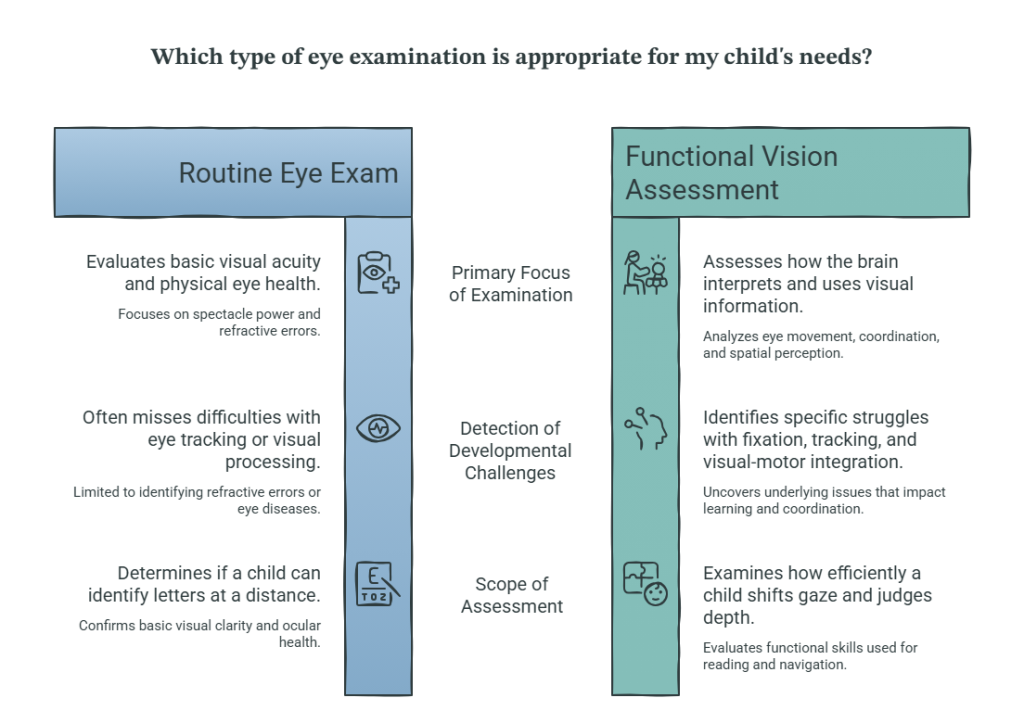
A child may have good visual acuity and still experience difficulties with how the eyes move, focus, coordinate and interpret visual information. These problems can sometimes go unnoticed during a routine eye examination, particularly when the examination focuses mainly on spectacle power, visual acuity and the health of the eyes.
Some children with autism may experience difficulties with:
Visual fixation – difficulty maintaining steady visual attention on a target
Oculomotor skills – difficulty with accurate eye movements, including saccades and smooth visual tracking
Eye-hand coordination – difficulty coordinating what the eyes see with what the hands need to do
Binocular vision – difficulty using both eyes together comfortably and efficiently
Visual attention – difficulty shifting attention from one visual target to another
Visual spatial perception – difficulty understanding position, distance, direction, depth or relationships between objects
Visual processing – difficulty making sense of or efficiently interpreting visual information
Visual-motor integration – difficulty using visual information to guide movement and tasks such as writing, copying, catching or navigating spaces
Importantly, these difficulties do not necessarily mean that the child has poor eyesight. A child may be able to read the eye chart reasonably well and still struggle with functional visual skills.
Research has identified atypical eye movements and visual-processing differences in children with autism, highlighting the importance of looking beyond visual acuity alone.
Why a Routine Eye Test May Not Tell the Whole Story
A routine eye examination is extremely important for detecting problems such as refractive error, squint, amblyopia and eye health conditions. However, it may not fully assess the functional visual skills that a child uses for learning, movement, attention and everyday activities.
For example, a conventional eye examination may establish whether a child can identify letters or pictures at a particular distance, but functional vision assessment may also look at how efficiently the child:
- Fixates on a target
- Moves the eyes while reading or following an object
- Tracks a moving target
- Shifts gaze between targets
- Uses both eyes together
- Judges depth and spatial relationships
- Coordinates vision with hand movements
- Processes and responds to visual information
This distinction can be particularly relevant when parents notice that their child can “see” but still struggles with reading, copying from the board, finding objects, navigating spaces, maintaining visual attention or coordinating visual tasks.
The goal is not to replace a comprehensive ophthalmic examination, but to identify visual skills that may require a more detailed functional assessment.
Signs That Your Child May Need a Functional Vision Assessment
Parents may consider discussing a detailed vision assessment if their child:
- Loses their place while reading
- Frequently skips or repeats words
- Has difficulty copying from a book or board
- Avoids visually demanding activities
- Has difficulty following a moving object
- Frequently looks away while performing visual tasks
- Takes longer to locate objects in a busy environment
- Struggles with stairs, uneven surfaces or judging distances
- Has difficulty with puzzles, blocks or visual-motor activities
- Shows unusual visual behaviours such as staring at objects, looking very closely or viewing objects from unusual angles
- Appears to see well but continues to struggle with visually demanding tasks
- Becomes tired, frustrated or overwhelmed during reading or other near-vision activities
These signs do not automatically indicate a vision disorder or autism-related visual dysfunction. However, they can be useful clues that a more detailed assessment may be appropriate.
8. Ask About Family Involvement
Parents and caregivers are really important in helping a child grow and develop. Good programs should give families useful information on how to include suggested strategies into their daily activities.
Ask whether parents receive guidance, progress updates, and suggestions for supporting skills at home. Consistency between professional sessions and home routines can help make developmental support more meaningful.
9. Review Progress Regularly
Autism support should not remain unchanged if a child’s needs or goals change. Regular progress reviews can help determine whether current strategies are helping and whether goals need to be modified.
Parents can ask how progress is documented and which outcomes are being monitored. Clear communication between professionals and families can make it easier to evaluate the effectiveness of a support plan.
10. Be Careful With Guaranteed Results
Parents need to be careful of services that say they can definitely cure a problem or claim that a single treatment works for all children. Autism is a condition that someone is born with and it affects how their brain develops.
The right support should help them grow in ways that matter, take part in activities they enjoy, express themselves, and live a fulfilling life.
It is usually better to use treatments that are supported by evidence and tailored to each person’s needs rather than those based on unproven ideas.
What Questions Should Parents Ask Before Choosing a Centre?
Before beginning any programme, parents can ask questions such as:
- What assessment will be performed before therapy?
- Which professionals will work with my child?
- How will individual goals be decided?
- How frequently will progress be reviewed?
- How will parents participate in the programme?
- What can be practised at home?
- How will the child’s strengths and preferences be considered?
- What happens if the current approach is not producing the expected progress?
The answers can help parents compare different options and select support that is appropriate for their child’s individual requirements.
Autism Support in Delhi at Sight First Vision Therapy By Dr Ahinav Maharwal
Families searching for Autism Support in Delhi may also have concerns related to visual development, eye coordination, focusing, or other vision-related skills. At Abhinav Maharwal, professional vision care can help assess individual visual needs and identify concerns that may affect activities such as reading, learning, visual attention, or everyday tasks.
Services may include comprehensive eye examinations, vision therapy, convergence insufficiency treatment, amblyopia or lazy eye treatment, squint eye treatment, myopia management, and other specialized vision care services where appropriate.
Vision related care should be based on a proper assessment rather than assuming that every child with autism requires vision therapy. The purpose of evaluation is to identify specific visual concerns and recommend suitable care when needed.
How Sight First Vision therapy by Abhinav Maharwal Can Help
At Sight First Vision therapy by Abhinav Maharwal, we look beyond simply asking whether a child can see clearly.
For children with autism and other developmental conditions, our approach can include assessment of functional visual skills such as fixation, eye movements, tracking, visual attention, binocular coordination, eye-hand coordination and visual-spatial skills.
Based on the assessment findings, an individualized vision therapy or functional vision programme may be recommended when appropriate.
The purpose is to help the child use their visual system more efficiently for everyday activities such as reading, learning, movement, coordination and interaction with their environment.
Vision therapy is not a treatment for autism itself. Rather, it is intended to address specific visual or visual-motor difficulties identified during assessment.
Conclusion
Choosing the right Autism Treatment in Delhi requires careful consideration of a child’s individual developmental, communication, behavioural, sensory, learning, and visual needs. Parents should choose qualified professionals, personalized assessment, realistic goals, family involvement, and regular progress monitoring.
Vision-related concerns should also be evaluated when symptoms or difficulties are present. Services such as vision therapy, comprehensive eye examinations, squint eye treatment, convergence insufficiency treatment, amblyopia or lazy eye treatment, and myopia management may be recommended when appropriate.
For professional guidance regarding your child’s visual needs, consult Dr. Abhinav Maharwal’s “Sight First Vision Therapy Clinics in Delhi and Jaipur” and schedule an evaluation to explore suitable vision care options.
FAQ’s
Parents should consider their child’s individual developmental, communication, learning, behavioural, sensory, and visual needs. A proper assessment, qualified professionals, personalized goals, family involvement, and regular progress monitoring are important factors when choosing suitable Autism Support in Delhi.
Depending on the child’s needs, support may include speech and language therapy, occupational therapy, behavioural support, special education, social skills training, parent guidance, and psychological assessment. The appropriate combination should be decided according to the child’s individual developmental profile.
Early assessment can help identify developmental and functional concerns and allow families to seek appropriate support. It can also help professionals establish realistic goals based on the child’s strengths and areas requiring additional assistance.
An individualized plan is developed after evaluating the child’s communication, learning, behaviour, sensory needs, social skills, and everyday functioning. Professionals can then establish specific goals and select suitable interventions while reviewing progress regularly.
Yes, a vision assessment may be useful when a child experiences difficulties with focusing, reading, eye coordination, visual attention, or other vision-related tasks. A comprehensive eye examination can identify refractive or binocular vision concerns that may require appropriate management.
Vision therapy may be considered when a child has specific visual skill or binocular vision difficulties identified through assessment. It is not a treatment for autism itself. The need for vision therapy should be determined by a qualified eye care professional based on the child’s individual visual needs.
Parents can ask about professional qualifications, assessment procedures, individualized treatment plans, therapy goals, progress monitoring, parent involvement, session frequency, and expected outcomes. They should also ask how the child’s strengths, preferences, and individual needs are incorporated into the support programme.
No. Autism affects each individual differently, so support and intervention should be personalized. One child may require greater assistance with communication, while another may need support with social interaction, sensory processing, learning, or daily living skills.
Depending on assessment findings, services may include comprehensive eye examinations, vision therapy, squint eye treatment, convergence insufficiency treatment, amblyopia or lazy eye treatment, and myopia management. These services should only be recommended when appropriate for the child’s identified visual needs.
Families looking for specialized vision care can consult At Sight First Vision therapy by Abhinav Maharwal, for an evaluation of individual visual needs. Depending on the assessment, appropriate services may be recommended to support vision, eye coordination, and related visual skills.